AI is incredible. I see it read handwritten documents, extract data from scanned contracts in seconds, and classify files that would take a human 20 minutes to sort through. It is a genuinely transformative technology.
But there is a growing belief that AI can do everything. People think you can build an entire business on prompts and that if AI can read a document, it can also do the math, validate the data, run the logic, and handle the edge cases.
It can’t. If you are making business decisions based on that assumption, this article is for you.
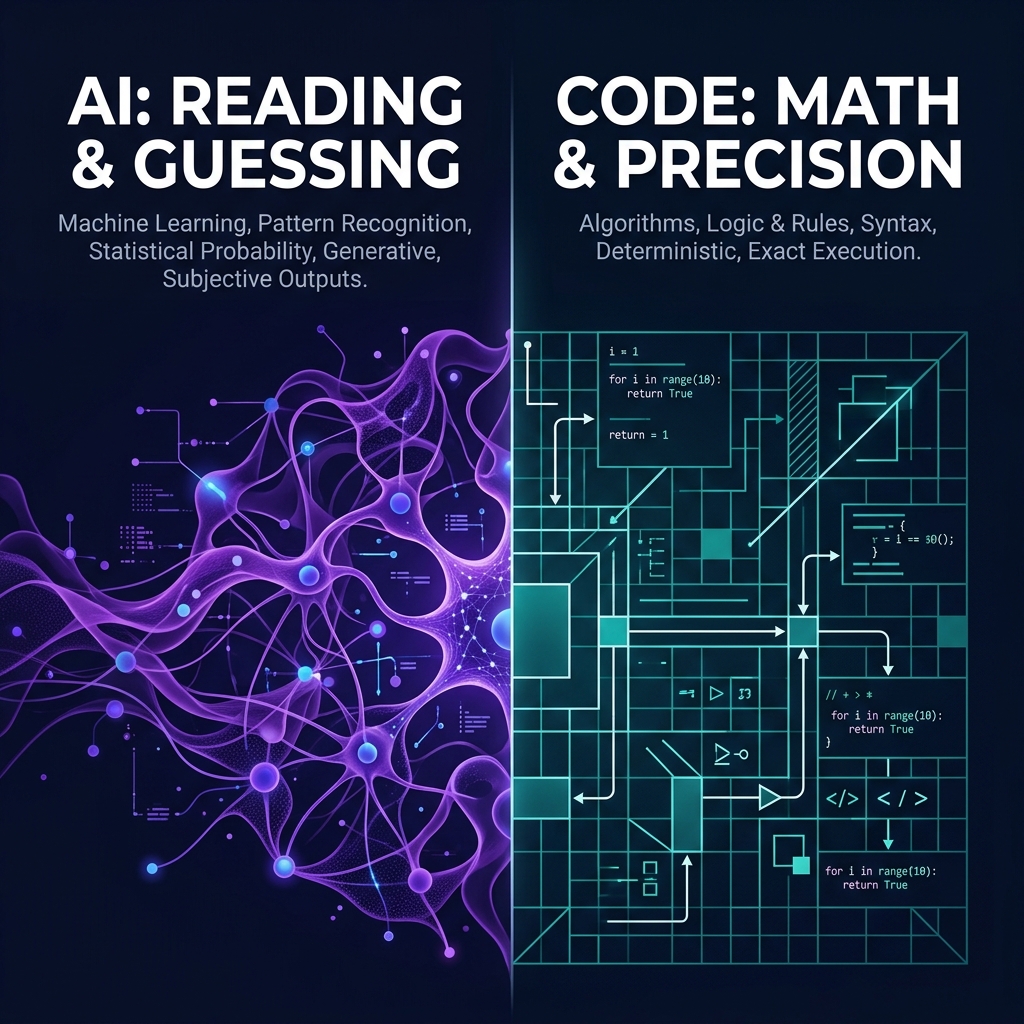
AI doesn’t calculate, it guesses
This is the single most important thing to understand about AI, and almost nobody talks about it.
When you ask ChatGPT what is 423.50 + 164.00 + 89.99, it doesn’t actually do the math. It does not open a calculator. It predicts what the answer probably looks like based on patterns it learned from billions of text examples. Most of the time it gets the right answer. Sometimes it doesn’t.
That is the difference between probabilistic and deterministic.
A calculator gives you 677.49 every time. There are no exceptions. AI gives you 677.49 most of the time. But occasionally it will give you 677.50, or 678, or say something like “approximately $677.”
For a casual question, who cares? But when it comes to your business invoices, payroll, tax filings, and financial reports, “most of the time” is not a standard you would accept from your accountant. You should not accept it from your software either.
The illusion of building it with AI
There is a new wave of tools that let you describe what you want, and AI generates a website, an app, or a dashboard. You type a prompt and get a product. It feels revolutionary, and for simple things it actually works.
But there is a big gap between a demo that works and software you can run a business on.
That AI-generated website might look great. It has forms, buttons, pages, and animations. But you have to ask yourself a few questions. Does it correctly calculate prices with tax, discounts, and currency conversion every time? If a customer enters invalid data, does it catch the error or silently accept it? Can it handle 1,000 orders at once without breaking?
These are not just cosmetic details. They are the difference between a prototype and an actual product.
AI can generate code, but generating code and engineering reliable software are two different disciplines. An architect does not just draw a building that looks nice, they make sure it doesn’t fall down.
Where AI is genuinely great
I am not anti-AI at all. But I use it for what it is actually good at. AI excels at tasks that require understanding. It is great at interpreting something unstructured or messy and making sense of it.
For example, reading documents. Give AI a scanned invoice or a photo of a receipt, and it can identify what type of document it is and pull out the key information. There are no rigid rules needed. It just reads.
It is also great at understanding language. AI can summarize a legal document, translate a contract, and answer questions about a report. It understands context in ways that traditional software never could.
In the document processing platforms I build, AI reads documents that come in every imaginable format. They are scanned, photographed, in different languages, and with varying layouts. AI handles that beautifully.
The critical part is knowing when to stop. The moment AI gives you the data, you should stop using AI. Everything after that like validating the numbers, checking if a tax ID is real, computing totals, and applying business rules needs to be traditional software. It needs to be precise and deterministic.
Where AI will silently fail you
The danger is not that AI fails spectacularly. It is that it fails quietly giving you an answer that looks right but isn’t.
Take money for example. AI can read an invoice and tell you the total is €4,823.50. That is impressive. But if you then ask AI to sum 200 invoices for a monthly financial report, you are trusting a system that guesses math to produce numbers you will use for your accounting. One silent rounding error, one hallucinated digit, and your books do not balance.
The same goes for validation. Is this VAT number real? Is this IBAN valid? These are not opinion questions. There is exactly one right answer, and a simple software formula gives it to you instantly every time. AI might tell you “yes, it looks valid” when a calculator would tell you it’s not.
Then there is scale. AI is phenomenal at one thing at a time. Give it one document and one task and it is excellent. But businesses process hundreds or thousands of documents. At scale, every small probability of error compounds.
If you have 97% accuracy on 10,000 documents, that means 300 errors your team has to find, review, and fix. Traditional software doing the same computation has zero errors. That is the difference between a system that scales and one that creating more manual work.
The vending machine vs the chef
A good analogy I use is comparing a chef to a vending machine.
AI is like a brilliant chef. Give them raw ingredients like a scanned document or a wall of unstructured text, and they will turn it into something useful. They can improvise, adapt, and handle surprises.
Traditional software is like a vending machine. It does exactly one thing the same way every time. You put in a coin and get your product. It doesn’t improvise because it doesn’t need to. It is reliable, fast, precise, and never gives you the wrong change.
You would not ask a vending machine to cook you dinner. But you also would not ask a chef to make change for a twenty, not because they can’t, but because the vending machine will never get it wrong.
The systems that actually work in production use the chef for cooking and the vending machine for change. AI reads the documents. Software does the math.
What this means for your business
If you are a business owner evaluating AI or deciding whether to build a tool with AI, keep this in mind.
Use AI for reading and understanding documents or emails. Use it to classify information, extract data from messy sources, and summarize or translate text. Use it anytime the input is ambiguous and requires interpretation.
Use traditional software for calculations like totals, taxes, and financial math. Use it for validation, checking formats, and enforcing rules. Use it for processing data at scale, like sorting and filtering thousands of records.
If someone tells you AI can do all of the above reliably, they are probably selling you a demo instead of a product.
AI is the most powerful technology to emerge in decades. But the businesses that win aren’t the ones that use AI for everything. They are the ones that use AI for the right things.
AI reads. Software thinks. The best products know exactly where one ends and the other begins.
I’d love to hear how you are thinking about AI in your business. Reach out on LinkedIn.